Divalent Metal Nanoparticles
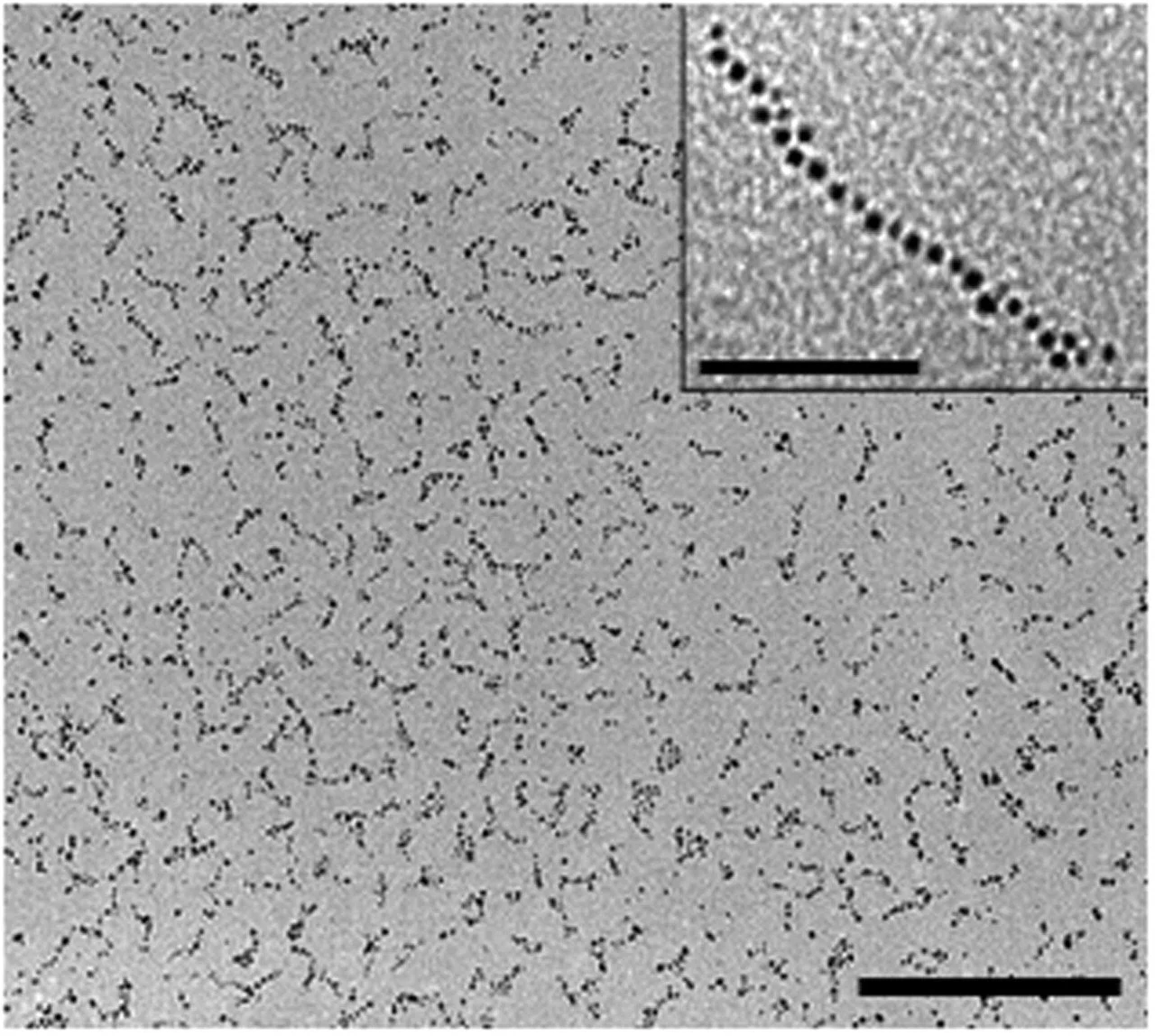
In undergraduate work, Brian wrote custom MATLAB software designed to identify the coordinates of individual nanoparticles on a zoomed out TEM image, measure the distance from neighboring particles to match the length of the linking molecule, and use a recursive algorithm to identify linear chains (and the number of nanoparticles they contain) while distinguishing them from agglomerations (chains with a loop) or individual nanoparticles (with no connectivity).
For more detail about the work I did to make the analysis in this paper possible please see my Undergraduate Thesis work from 2005, this paper talks a great deal about this “polymerization” technique but the underlying statistics relied entirely upon hundreds of hours of work in developing the statistics software required to do thermodynamic calculations to prove that the technique worked.
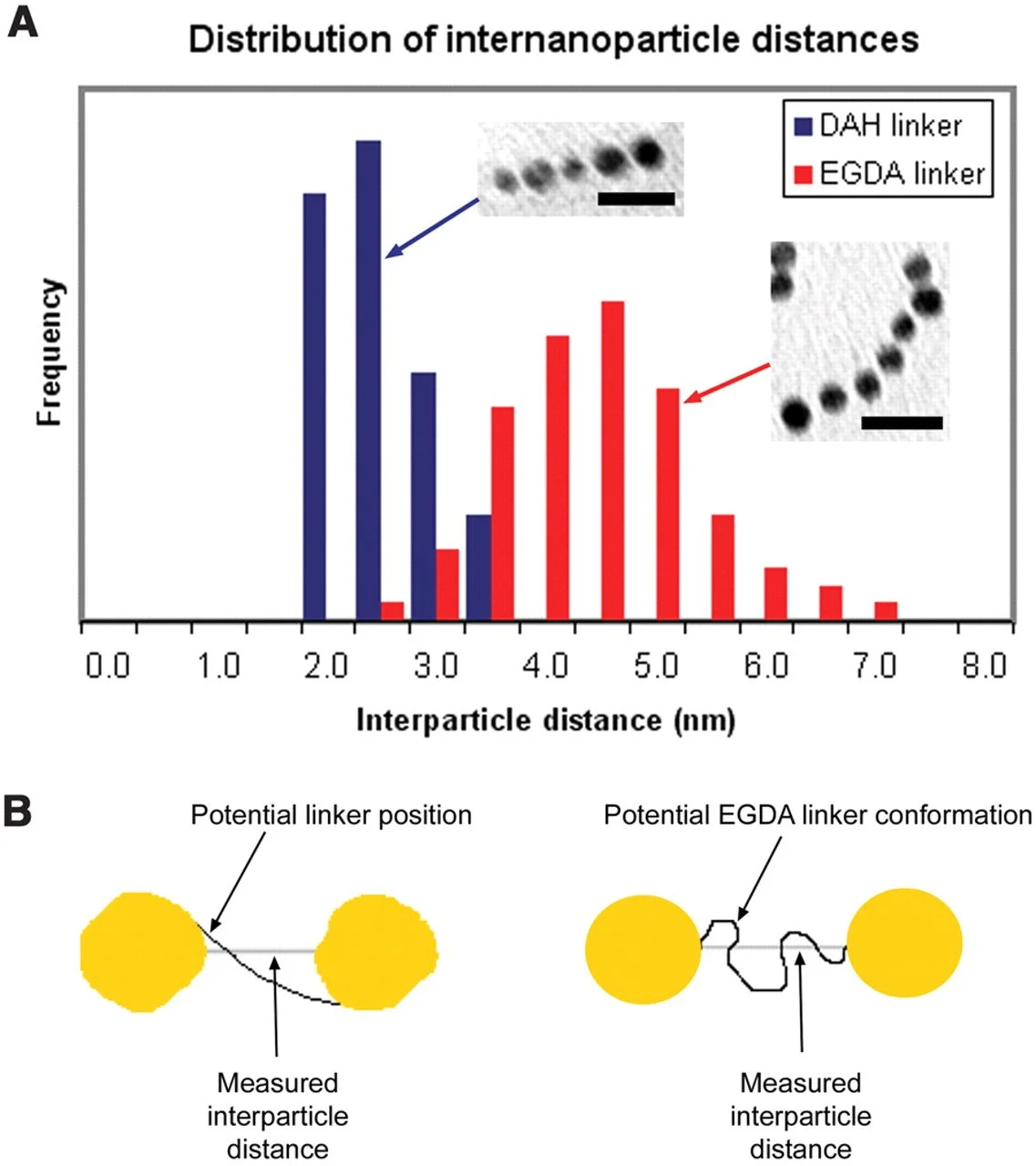
With this data distinguishing isolated particles, chains, and agglomerations it was possible to compare samples made with and without linkers or polar defects directly to estimate thermodynamic driving forces. The software analysis tool made it possible to prove statistically that there were actually longer chains formed with linear defects than without, avoiding the common scientific issues with relying on microscope images to make generalizations from a few close up images. Brian’s algorithm was used with hundreds of TEM images captured on film and digitized to produce the graphs below.
While working in this research lab Brian learned chemical synthesis of nanomaterials and made triangular structures with single stranded DNA linkers as detailed in his thesis from May 2005.
Gretchen A. DeVries et al., Divalent Metal Nanoparticles. Science 315, 358-361(2007). DOI:10.1126/science.1133162